
Lower terrain generally supports higher atmospheric pressure than elevated terrain. MOLA elevation therefore provides a necessary spatial variable for every pressure comparison.
MARS ATMOSPHERE
Atmosphere and Pressure on Mars
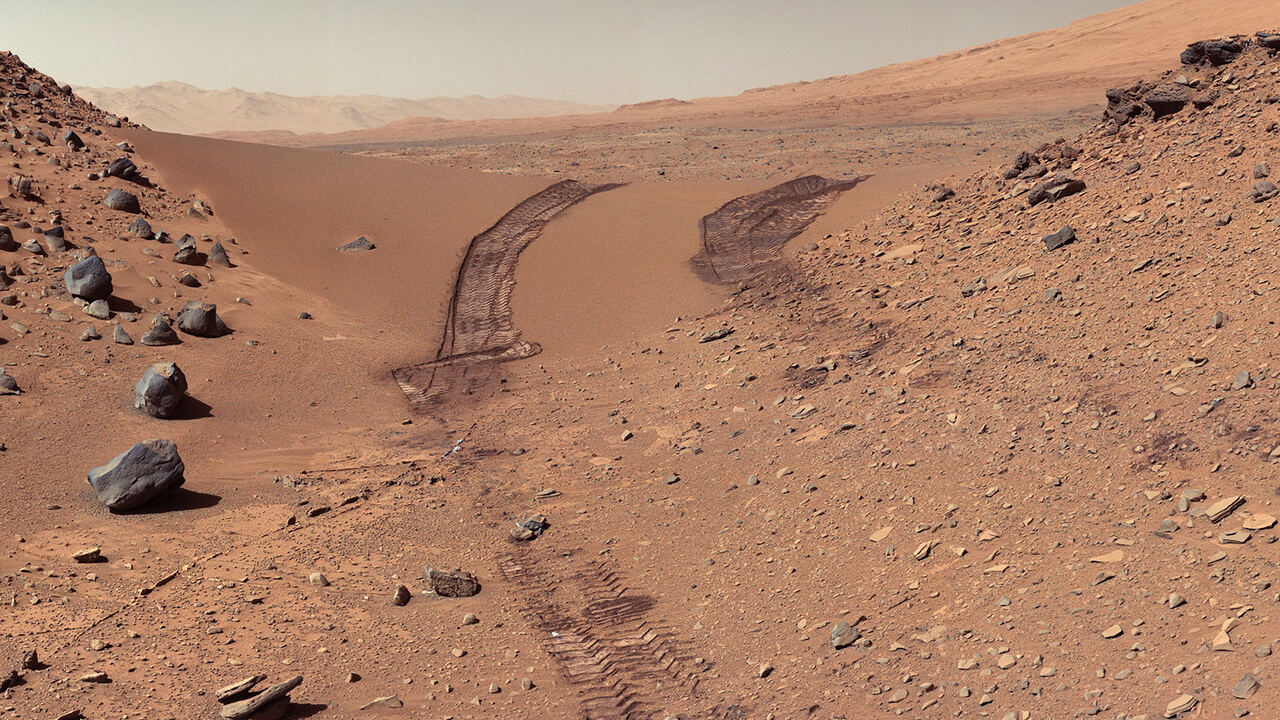
Mars has a thin carbon-dioxide-dominated atmosphere. Pressure changes with elevation and season, while dust can alter visibility, heating and the interpretation of local conditions.
Wind values describe model or station context at a defined place and time. Dust loading affects atmospheric opacity and can change the thermal environment over regional and planetary scales.
A pressure record from a rover, a global climatology and a scenario estimate are not interchangeable. The interface retains each class so users can compare without losing provenance.
Scientific dossier
A thin atmosphere with a long climate history
The modern atmosphere is dominated by carbon dioxide and shaped by seasonal frost, dust, topography and interaction with space. Ancient rivers and lakes make atmospheric evolution central to Mars science.
Composition and pressure
Carbon dioxide is the principal gas, with nitrogen and argon as important minor components. Surface pressure changes with elevation and as carbon dioxide condenses onto and sublimates from seasonal polar caps.
Climate evolution
Valley networks, deltas and water-altered minerals indicate past environments unlike today's. Research examines how atmospheric escape, declining internal activity and climate feedbacks transformed a wetter planet into a cold desert.
Dust, water and observation
Dust changes atmospheric heating and helps form ice clouds. Orbiters provide regional coverage, surface missions provide local time series, and assimilation models connect sparse observations without becoming measurements at every coordinate.
Primary reading and data sources
Explore the Mars knowledge system
MARS WEATHERMars Weather: Temperature, Pressure and Wind3D MARS GLOBEInteractive 3D Mars GlobePLANETARY CARTOGRAPHYInteractive Map of MarsTHERMAL ENVIRONMENTTemperature on MarsRADIATION ENVIRONMENTRadiation on MarsSOURCE REGISTRYMars Scientific Data SourcesREPRODUCIBLE METHODMars Operations Methodology