
The Radiation Assessment Detector provides surface measurements associated with mission time intervals. The dashboard preserves the dataset release and observation window instead of labelling archived values as current.
RADIATION ENVIRONMENT
Radiation on Mars
Mars radiation is shaped by galactic cosmic rays, solar energetic particles, atmospheric shielding and local topography. Public radiation records are scientific releases, not a continuous planet-wide live meter.
A surface instrument samples one local environment. Planet-wide interpretation requires atmospheric and transport models and must remain visibly separate from direct observations.
Radiation affects shielding, mission duration and infrastructure design. Suitability scoring uses it as one constrained input and never as a complete safety verdict.
Scientific dossier
Radiation at the surface of Mars
Mars lacks a present global magnetic field and has a thin atmosphere, so energetic particles are a major scientific and engineering concern. Radiation is time-dependent and instrument-specific, not a universal live score.
Galactic and solar sources
Galactic cosmic rays form a persistent high-energy background. Solar energetic-particle events are episodic and can increase exposure rapidly. Their importance changes with solar activity and shielding.
Curiosity RAD measurements
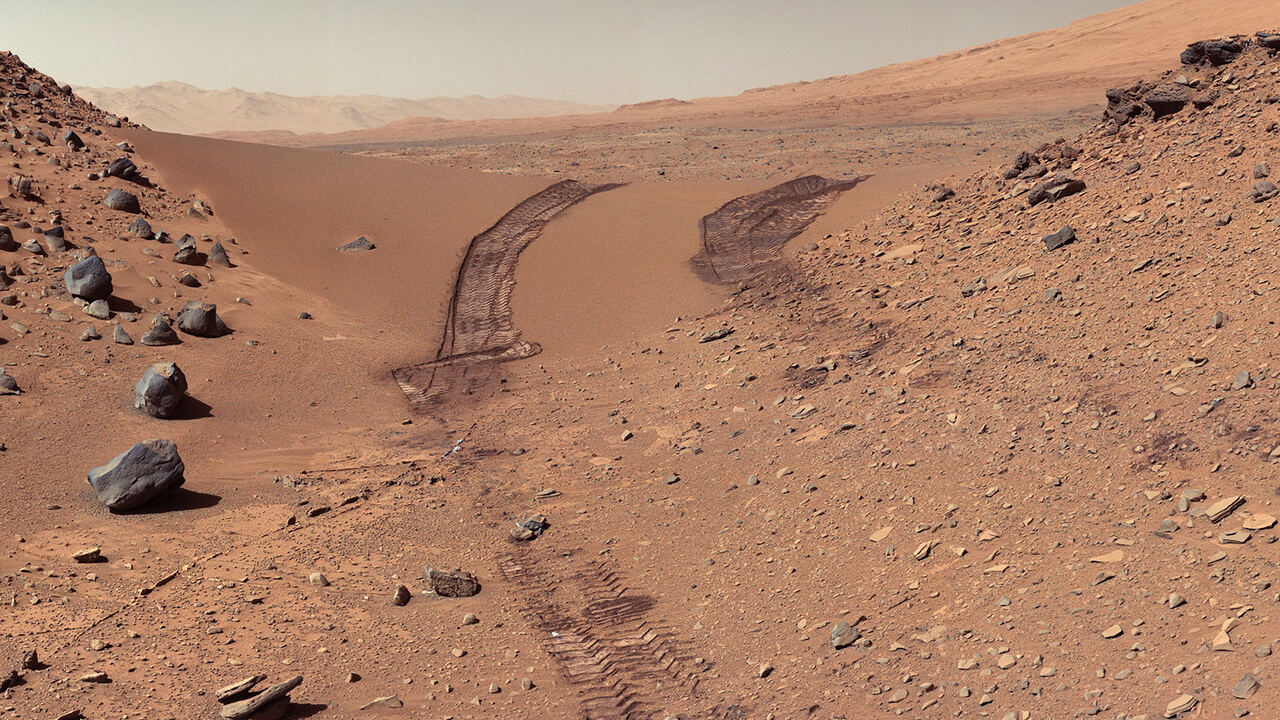
RAD measured radiation during the cruise to Mars and continues at Gale crater. Released records support studies of dose, particle spectra, solar events and shielding conditions.
Terrain, shielding and archive time
Elevation changes atmospheric shielding and terrain blocks part of the sky. An archive release date is not the date of every observation: interpretation needs covered sols, processing level, units and calibration.
Primary reading and data sources
Explore the Mars knowledge system
MARS WEATHERMars Weather: Temperature, Pressure and Wind3D MARS GLOBEInteractive 3D Mars GlobePLANETARY CARTOGRAPHYInteractive Map of MarsTHERMAL ENVIRONMENTTemperature on MarsMARS ATMOSPHEREAtmosphere and Pressure on MarsSOURCE REGISTRYMars Scientific Data SourcesREPRODUCIBLE METHODMars Operations Methodology