
NASA Planetary Data System and ESA Planetary Science Archive provide mission and instrument records. The application links outward to authoritative records rather than reproducing unsupported claims.
SOURCE REGISTRY
Mars Scientific Data Sources
The system combines authoritative public planetary archives while retaining source name, record URL, dataset version, observation time and evidence class. Integration does not make heterogeneous records equivalent.
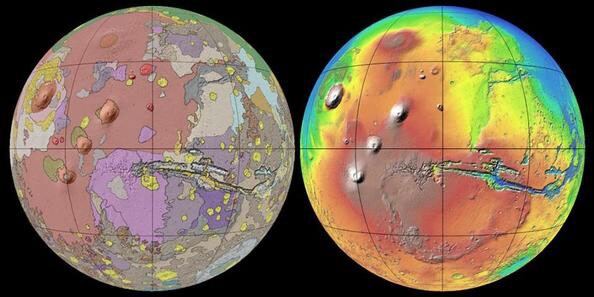
MOLA gridded topography supplies the global elevation framework. Coordinates and elevations are normalized before they enter the public Rust API.
Observed, modelled, derived and archived values carry separate labels. Version and timestamp fields make it possible to audit what the interface shows and when the underlying source was published.
Scientific dossier
A source architecture for planetary evidence
Mars research depends on products from different missions, instruments, processing teams and archives. A useful system preserves those differences while making records searchable, comparable and reproducible.
Mission and instrument context
A measurement needs mission, instrument, target, geometry, time, calibration and processing level. The same quantity may be represented differently in raw, calibrated and derived products.
Planetary archives
NASA PDS and ESA PSA preserve mission products and documentation. USGS Astrogeology and mission teams add controlled mosaics, terrain and geologic interpretations.
Normalization and quality control
The Rust layer normalizes selected fields while retaining source identity, evidence class, observation date, retrieval date and model version. Automated checks detect format and range problems; scientific validity still requires domain review.
Primary reading and data sources
Explore the Mars knowledge system
MARS WEATHERMars Weather: Temperature, Pressure and Wind3D MARS GLOBEInteractive 3D Mars GlobePLANETARY CARTOGRAPHYInteractive Map of MarsTHERMAL ENVIRONMENTTemperature on MarsMARS ATMOSPHEREAtmosphere and Pressure on MarsRADIATION ENVIRONMENTRadiation on MarsREPRODUCIBLE METHODMars Operations Methodology